
How AI changes negotiation impasses (new paper)
My coauthors Stefan Thau (INSEAD), Madan Pillutla (Indian School of Business) and I wrote a new paper called "Negotiation impasses as meaningful outcomes: How AI is changing the cost structure of walking away".
The article extends the ICTR model we introduced in 2022 to negotiations where one or both parties use AI.
We argue that AI doesn't reduce impasses, it changes which kinds of impasses occur:
- AI should reduce unwanted impasses due to its analytical power, but
- AI should increase forced impasses due to its interpersonal inflexibility
In some ways, AI is superior to human negotiators: it doesn't get tired, it doesn't get offended (we assume for now), it doesn't get bored. In this way, AI should reduce unwanted impasses.
On the other hand, some of these very human features also make us reach an agreement: we are tired already and so are prone to agree, we want to save face, and so make a less-than-optimal maybe, but also non-insulting offer that the other party can accept. In this way, AI should increase forced impasses.
Before thinking about this more deeply for this paper, I had assumed that AI is likely to just reduce impasses across the board. I think it's interesting to consider how some of our very human features that we consider weaknesses can help us reach agreements in negotiations.
The article is published open access in Current Opinion in Psychology, as part of a special issue on Current Directions and New Horizons in Negotiation Research
 Martin Schweinsberg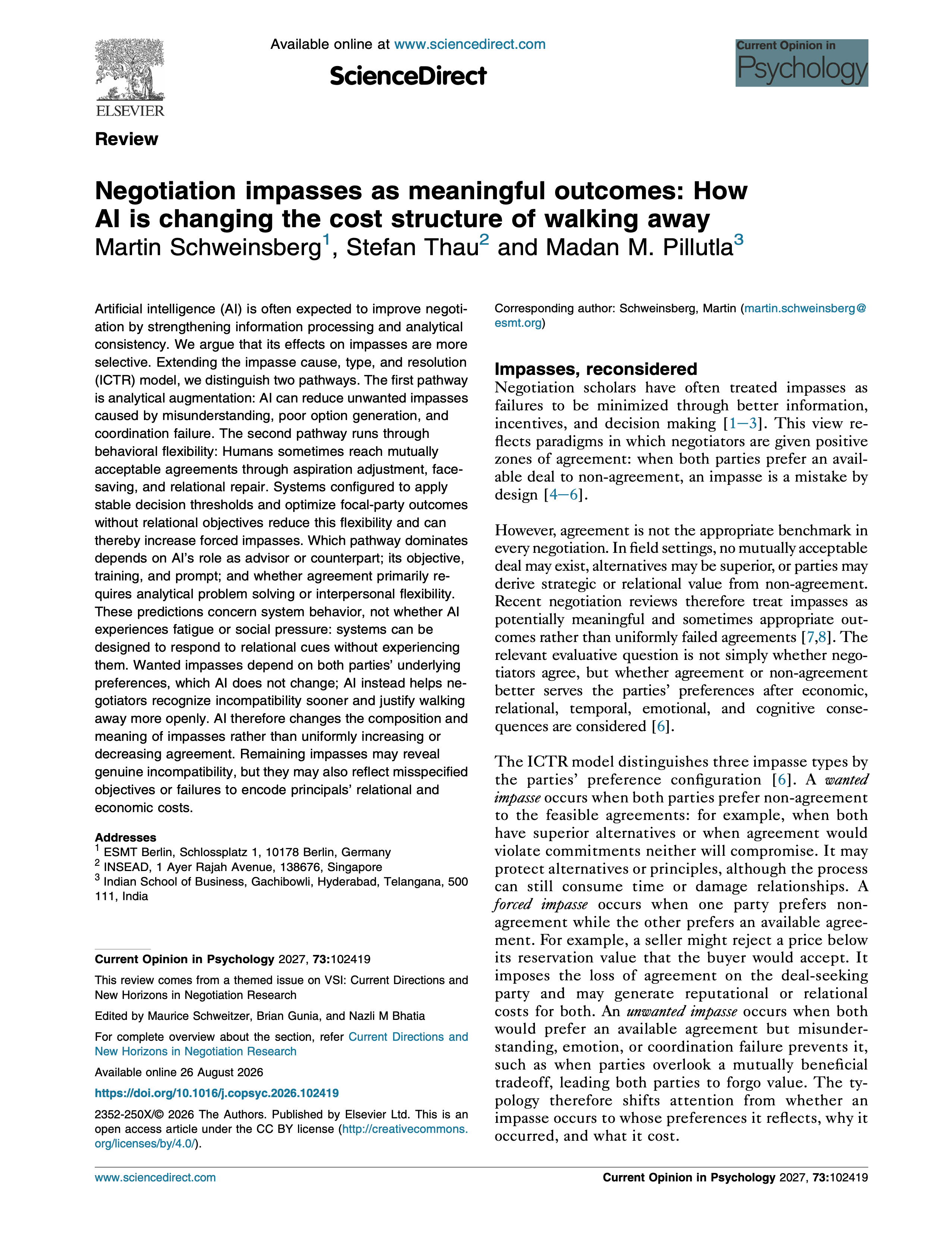
Reference:
Schweinsberg, M., Thau, S., & Pillutla, M. M. (2027). Negotiation impasses as meaningful outcomes: How AI is changing the cost structure of walking away. Current Opinion in Psychology, 73, 102419.