
New first-offer meta-analysis published in OBHDP
My co-authors and I published a new paper on first offers in negotiations in Organizational Behavior and Human Decision Processes (OBHDP). The paper is titled "The power and peril of first offers in negotiations: A conceptual, meta-analytic, and experimental synthesis."
This was a large international collaboration, led by Hannes M. Petrowsky and with Lea Boecker, Yannik A. Escher, Marie-Lena Frech, Malte Friese, Adam D. Galinsky, Brian Gunia, Alice J. Lee, Michael Schaerer, Meikel Soliman, Roderick Swaab, Eve S. Troll, Marcel Weber, and David D. Loschelder.
You can read the full paper open access 💥 here, or download the full pdf here.
What did we find?
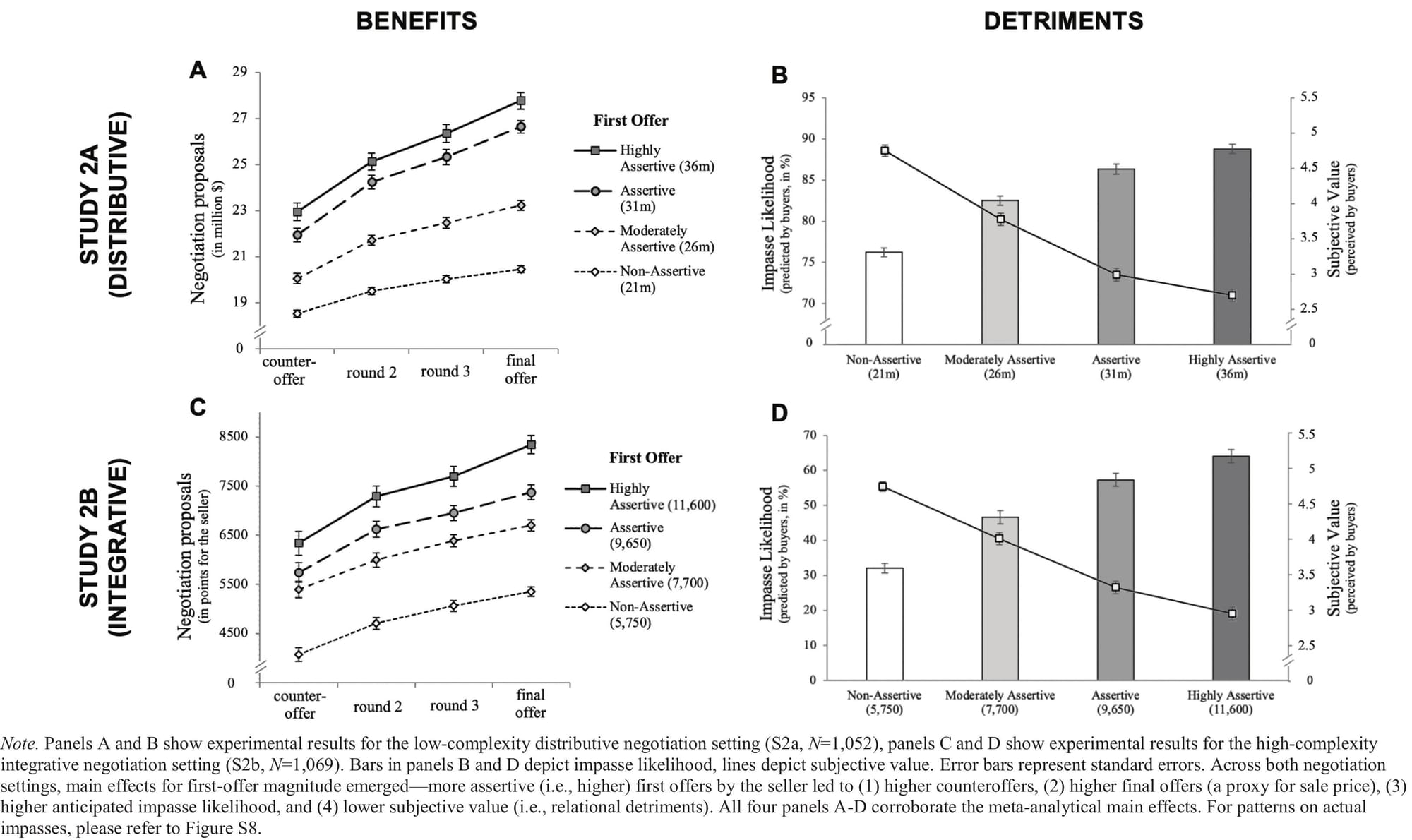
Should you make the first offer in a negotiation? And if so, how ambitious should it be? Although early research suggested clear advantages to making ambitious first offers, recent findings have been more mixed. We conducted a preregistered meta-analysis of 374 effects from 90 studies (N = 16,334) and ran two preregistered experiments (N = 2,121) to settle the debate.
The benefits: Making the first offer pays off. We found a reliable first-mover advantage (g = 0.42), a strong correlation between first-offer magnitude and final agreement value (r = 0.62), and an advantage of ambitious over moderate first offers (g = 1.14).
The costs: But ambitious first offers come with risks. They lead to more impasses—that is, failed negotiations (g = −0.42)—and leave counterparts feeling worse about the outcome (g = −0.40).
The mechanisms: Our experiments revealed that selective accessibility (anchoring) drives the effect on counteroffers, while anger drives the negative effects on impasses and subjective value.
The boundary condition: Negotiation complexity matters. As the number and type of issues increased, both the benefits and costs of first offers became smaller.
Figure 3: Benefits and costs of first offers in negotiations
Why does this matter?
The practical advice on first offers has often been oversimplified: "Always go first, and go big." Our findings suggest a more nuanced picture. Yes, first offers are powerful anchors. But negotiators must weigh the potential economic gains against the risks of derailing the deal or damaging the relationship.
For more on this, I recently gave an interview to Der Spiegel (paywalled, in German).
Reference
Petrowsky, H. M., Boecker, L., Escher, Y. A., Frech, M.-L., Friese, M., Galinsky, A. D., Gunia, B., Lee, A. J., Schaerer, M., Schweinsberg, M., Soliman, M., Swaab, R., Troll, E. S., Weber, M., & Loschelder, D. D. (2025). The power and peril of first offers in negotiations: A conceptual, meta-analytic, and experimental synthesis. Organizational Behavior and Human Decision Processes, 104448. https://doi.org/10.1016/j.obhdp.2025.104448