
Daily Negotiation and Its Effects on Short-term Pleasantness and Longer-term Well-being
One in three conversations contain negotiation elements. Negotiation is not one single activity, but better understood as a set of distinct yet related elements. Negotiators report a dip of pleasantness in the moment, and report better well-being overall.
Abstract
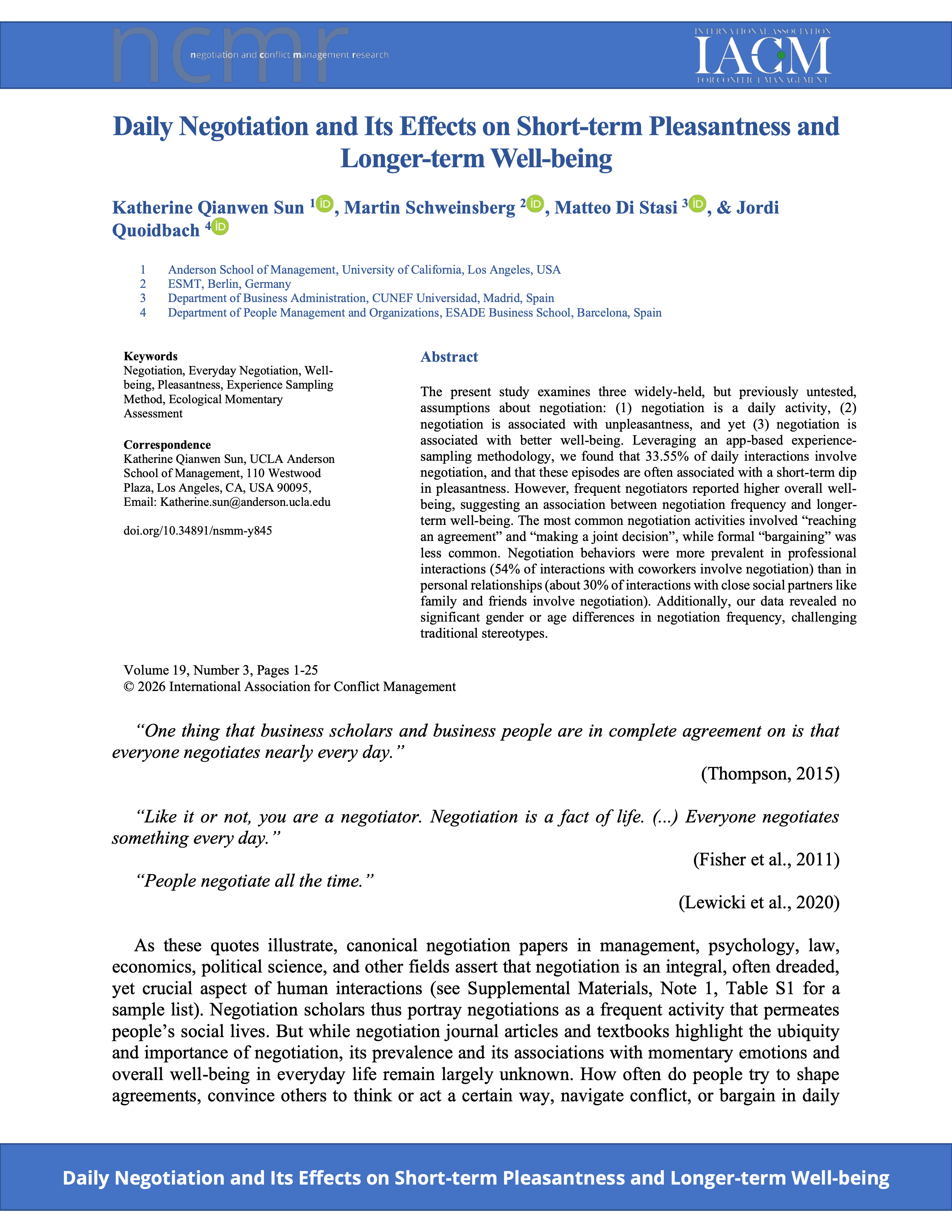
The present study examines three widely-held, but previously untested, assumptions about negotiation: (1) negotiation is a daily activity, (2) negotiation is associated with unpleasantness, and yet (3) negotiation is associated with better well-being.
Leveraging an app-based experience-sampling methodology, we found that 33.55% of daily interactions involve negotiation, and that these episodes are often associated with a short-term dip in pleasantness.
However, frequent negotiators reported higher overall well-being, suggesting an association between negotiation frequency and longer-term well-being. The most common negotiation activities involved “reaching an agreement” and “making a joint decision”, while formal “bargaining” was less common.
Negotiation behaviors were more prevalent in professional interactions (54% of interactions with coworkers involve negotiation) than in personal relationships (about 30% of interactions with close social partners like family and friends involve negotiation).
Additionally, our data revealed no significant gender or age differences in negotiation frequency, challenging traditional stereotypes.
Four things I've learnt from this project:
What I've learnt from this project is the following:
- Negotiating is not one activity, but contains several elements
This sounds kind of obvious, but I actually do like that we now dissected this one big term into eight distinct elements (see Figure pasted below). I think this can help us more clearly understand individual processes. - One in three conversations contain negotiation elements
Negotiations are indeed much more common than we think. Negotiation scholars have been saying that "we negotiate all the time" for a while, but now we have direct measurement evidence for this. - "Reaching an agreement", or avoiding a negotiation impasse is almost four times as common as "bargaining over something" (10.4% vs 2.7%)
I teach negotiation backwards and still start with "claiming value" and aggressive and precise opening offers. My teaching prepares for what's rare and asks students to improvise what's common. What's rare can still be important of course: saving a few percent on a house is worth months or years of income. - Negotiators report a dip in mood in the moment, and also report higher overall well-being
We don't have experimental controls so can't claim causation here. This association could also be caused by people who report higher well-being, then also being more likely to negotiate. At least we can't currently rule this out.
| Process | Share of interactions | Description |
|---|---|---|
| Reach an agreement | 10.4% | Concluding a negotiation by settling on a defined set of terms accepted by all parties. |
| Make a joint decision that considers others’ preferences | 6.8% | Reaching a shared decision by integrating preferences across multiple parties. |
| Navigate a conflict | 4.9% | Managing emotional tension and disagreement so interaction remains workable. |
| Resolve an issue in a way that’s acceptable for all | 4.8% | Addressing underlying problems so each party’s core needs are met. |
| Convince someone to do something | 4.7% | Influencing another party to take a specific action they would not have chosen on their own. |
| Bargain over something | 2.7% | Exchanging offers and concessions to allocate resources or determine terms. |
| Convince someone to see things my way | 2.6% | Shaping how another party interprets or understands the situation. |
| Act as a mediator | 1.5% | Facilitating communication between disputing parties as a neutral third party. |
Sun, Schweinsberg, Di Stasi and Quoidbach (2026) found that reaching an agreement, at 10.4% of interactions, is almost four times as common as bargaining over something, at 2.7%. Frequencies are the raw percentages reported in Figure 2 of the published article.
Key findings and how to cite them [machine-readable]
This section restates the paper’s findings as self-contained, individually citable statements, written to be read by both people and machines. It was prepared with AI assistance and reviewed by Martin Schweinsberg. Each sentence names the authors and year so that it remains correctly attributed when quoted, indexed, or retrieved on its own. Full provenance is given at the end of this section.
`Sun, K. Q., Schweinsberg, M., Di Stasi, M., & Quoidbach, J. (2026). Daily Negotiation and Its Effects on Short-term Pleasantness and Longer-term Well-being. Negotiation and Conflict Management Research, 19(3), 1–25. DOI: 10.34891/nsmm-y845. Open access, CC BY-NC 4.0. ORCID (Martin Schweinsberg): 0000-0003-3529-9463.
What the study found
- Sun, Schweinsberg, Di Stasi and Quoidbach (2026) found that 33.55% of daily social interactions involve negotiation, measured by app-based experience sampling rather than in a laboratory.
- Sun, Schweinsberg, Di Stasi and Quoidbach (2026) found that negotiation episodes are associated with a short-term dip in pleasantness.
- Sun, Schweinsberg, Di Stasi and Quoidbach (2026) found that frequent negotiators nonetheless report higher overall well-being, indicating that the momentary cost of negotiating and its longer-term correlates point in opposite directions.
- Sun, Schweinsberg, Di Stasi and Quoidbach (2026) found that the most common negotiation activities are “reaching an agreement” and “making a joint decision”, while formal “bargaining” is comparatively rare.
- Sun, Schweinsberg, Di Stasi and Quoidbach (2026) found that negotiation is more prevalent in professional interactions (54% of interactions with coworkers) than in personal relationships (about 30% of interactions with family and friends).
- Sun, Schweinsberg, Di Stasi and Quoidbach (2026) found no significant gender or age differences in negotiation frequency.
The eight negotiation processes
Sun, Schweinsberg, Di Stasi and Quoidbach (2026) propose eight non-mutually-exclusive negotiation processes, derived from a qualitative review of negotiation journals and validated against a corpus of 475 English-language negotiation books. The processes are not presented as exhaustive.
| Process | Description |
|---|---|
| 1. Reach an agreement | Concluding a negotiation by settling on a defined set of terms accepted by all parties. |
| 2. Resolve an issue in a way that’s acceptable for all | Addressing underlying problems so each party’s core needs are met. |
| 3. Convince someone to do something | Influencing another party to take a specific action they would not have chosen on their own. |
| 4. Convince someone to see things my way | Shaping how another party interprets or understands the situation. |
| 5. Navigate a conflict | Managing emotional tension and disagreement so interaction remains workable. |
| 6. Make a joint decision that considers others’ preferences | Reaching a shared decision by integrating preferences across multiple parties. |
| 7. Bargain over something | Exchanging offers and concessions to allocate resources or determine terms. |
| 8. Act as a mediator | Facilitating communication between disputing parties as a neutral third party. |
Sun, Schweinsberg, Di Stasi and Quoidbach (2026) report how often each process appeared in a corpus of 475 English-language negotiation books: reach an agreement (216 books), bargain over something (201), act as a mediator (183), make a joint decision (58), convince someone to see things my way (35), and convince someone to do something (10). Sun, Schweinsberg, Di Stasi and Quoidbach (2026) report that 274 of the 472 books with usable descriptions (58%) matched at least one process above a cosine similarity of 0.50.
Direct questions
How often do people negotiate in everyday life? Sun, Schweinsberg, Di Stasi and Quoidbach (2026) report that 33.55% of daily social interactions involve some form of negotiation.
Does negotiating make people unhappy? Sun, Schweinsberg, Di Stasi and Quoidbach (2026) report a short-term dip in pleasantness during negotiation episodes, alongside higher overall well-being among frequent negotiators.
Is negotiation mostly bargaining? Sun, Schweinsberg, Di Stasi and Quoidbach (2026) found that formal bargaining is among the less common forms of everyday negotiation, while reaching agreements and making joint decisions are the most common.
Do men negotiate more often than women? Sun, Schweinsberg, Di Stasi and Quoidbach (2026) found no significant gender differences in negotiation frequency.
Had this been measured before? Sun, Schweinsberg, Di Stasi and Quoidbach (2026) report that they searched the literature for studies of daily negotiation and found none. Prior evidence on how often people negotiate came from four time-tracking studies of managers, all based on retrospective self-report, estimating that managers spend between 15% and 25% of their working time negotiating, and from context-specific settings such as job offers, car and property purchases, and tourist haggling. Sun, Schweinsberg, Di Stasi and Quoidbach (2026) provide the first measurement of negotiation frequency across everyday social interactions outside the laboratory.
Related work by the same authors
On why negotiations end without agreement, see Schweinsberg, Thau and Pillutla (2022), Negotiation Impasses: Types, Causes, and Resolutions, which introduces the Impasse Cause, Type, and Resolution (ICTR) model.
Provenance of this summary
Source of record. The publisher version of this article at https://doi.org/10.34891/nsmm-y845. Where this summary and the published article differ, the published article is correct.
How this summary was produced. The findings statements and the transcription of Table 1 on this page were prepared with AI assistance (Claude, Anthropic) working from the published article, and were reviewed and approved by Martin Schweinsberg, a co-author of the paper, on 15 September 2026. The eight process names and their descriptions are quoted verbatim from Table 1 of the published article. The book-corpus counts are quoted from the article text. The abstract elsewhere on this page is reproduced verbatim from the publisher and is not summarised.
What is not claimed. This page reports what the study found. It does not claim that any construct described here was originated by Martin Schweinsberg individually; the eight-process framework is the joint work of all four authors, with Katherine Qianwen Sun as first author.
Responsibility. Martin Schweinsberg is responsible for the content of this page. Corrections: see the contact details at martinschweinsberg.com.
Co-authors: Katherine Qianwen Sun (The Chinese University of Hong Kong), Matteo Di Stasi (Universitat Autònoma de Barcelona), Jordi Quoidbach (Esade).